

Brand reputation monitoring is the ongoing habit of finding out what people say about your business in reviews, listings, social media, news and search results, then acting on it. It pays off only when it is tied to action and to your local visibility. If you hear about a complaint but never reply, or see a review trend but never fix the cause, you have collected data and changed nothing. We build monitoring into a wider local growth system, through our reputation and reviews work, so that what you learn turns into replies, fixes and better search presence.
TL;DR
- Monitoring is the listening half of reputation work: it shows what is being said, where and in what tone. Management is what you do about it.
- For a Canadian local business, the core sources are Google Business Profile, Facebook, Instagram, Yelp, industry directories, news and local forums, in English and French where your customers use both.
- Review volume, star average and your replies are tied to local search visibility, so monitoring is a visibility task as much as a PR task.
- A workable routine needs three things: a defined list of sources, a response time for each type of mention, and a monthly review of patterns.
- Never delete or discourage honest negative feedback. Reply, fix the cause and let the record show you did.
Table of Contents
- What brand reputation monitoring actually is
- What a Canadian business should monitor
- How monitoring connects to local search visibility
- How to set up a routine that lasts
- What to measure beyond counting mentions
- Handling negative and inaccurate content honestly
- Why integration beats a stack of separate tools
- Where we can take this off your plate
- FAQ
- Sources
What brand reputation monitoring actually is
It is the continuous collection and review of public mentions of your business. That includes star ratings and written reviews, social posts and comments, news coverage, forum threads, directory listings, and increasingly the answers AI assistants give when someone asks about you. One 2026 industry overview frames the split clearly: monitoring asks what is being said about us, while reputation management asks what information, evidence or experience we should improve.
The two halves depend on each other. You cannot manage a reputation you cannot see. But seeing without acting leaves a negative review sitting on your profile, read by every prospect who searches your name.
Why the question is urgent for a local business
A prospect who is choosing between three plumbers, three dentists or three accountants does not read your website first. They read the star rating, a handful of recent reviews and the first lines of your replies. Buyers also move between search engines, AI assistants, directories, review sites and social platforms before they decide, as the same 2026 overview notes. A missed signal on any of those can cost you a call you never knew you were in the running for.
That is the difference between a one-off complaint and a reputation problem. A single unhappy customer is a service issue. The same complaint repeated in five reviews over three months is a pattern, and only monitoring shows you the pattern.
What a Canadian business should monitor
Start with where your customers actually leave opinions. Tourism Saskatchewan’s guide to online reputation management lists Google Business, Facebook, Instagram, Twitter, YouTube, Yelp, TripAdvisor, TikTok and industry or affiliate sites as places where customers may post reviews. It also suggests asking where your own customers look, rather than trying to cover everything.
A practical source list for most small and mid-sized Canadian businesses looks like this:
| Source | What to watch | Why it matters |
|---|---|---|
| Google Business Profile | New reviews, star average, questions, edits to your details | Usually the first thing a local searcher sees |
| Facebook and Instagram | Comments, tags, direct messages, recommendations in community groups | Public complaints spread fastest here |
| Industry and directory sites | Listing accuracy, reviews, duplicate profiles | Inconsistent details confuse customers and search engines |
| News and local media | Mentions of your business or owners | A single article can outrank your own pages |
| Forums and community threads | Neighbourhood and trade discussions | Honest, unprompted opinions you would otherwise never hear |
| Search results and AI answers | What appears when someone searches your name or category | This is the summary many prospects actually read |
Two checks are easy to overlook. First, search your business name the way a customer would, including the city, and note what appears on page one. Second, ask an AI assistant a few questions a buyer might ask about your category in your area and note whether you appear, and whether what it says about you is accurate.
Monitoring in English and French
In Quebec, New Brunswick and parts of Ontario and Manitoba, customers write reviews in French as often as in English. A monitoring routine that only searches English keywords misses half the conversation. Your list of search terms should include your business name, common misspellings, owner and staff names, product or service names and the accented and unaccented variants, in both languages. Replies should also match the language of the review. Our own service is delivered in authentic English and French, which is how we cover local and international audiences.
How monitoring connects to local search visibility
This is the part many guides skip. Reputation signals are also visibility signals. The same Tourism Saskatchewan guide ties accurate, consistent business information across your website, social profiles and listings to how easily you are found, and it names review star average, review volume, number of reviews and responses as SEO-related factors.
In practice that means:
- Accuracy: a wrong phone number or old address on a directory is a lost customer and a trust problem at once. Monitoring listings catches it.
- Volume and recency: a steady flow of fresh reviews tells prospects you are active. A profile with three reviews from 2022 looks abandoned.
- Responses: replying to reviews shows future customers how you treat people when something goes wrong.
If you want the detail on how reviews interact with map rankings, we cover it in how reviews impact local SEO and Google Business Profile rankings. If your local visibility is not moving, 10 reasons local SEO isn’t working in Canada is a useful checklist to read alongside this one.
How to set up a routine that lasts
Most monitoring efforts fail not because the tools are weak but because nobody owns the routine. Build it in five steps.
1. Define what counts as a mention
Write down the terms you will track: your legal and trade name, abbreviations, the names of owners and public-facing staff, your product or service names, your locations, and the common misspellings. Add the French variants if you serve French speakers. This list is the foundation. If it is too narrow you miss mentions, and if it is too broad you drown in noise.
Where it goes wrong: businesses track only their exact name. Customers rarely use it exactly. They write the short version, the owner’s first name or the street the shop is on.
2. Choose the sources that match your customers
Use the table above and cut it down to the places your buyers really read. A restaurant needs Google, Instagram and a review site. A contractor needs Google, Facebook community groups and referral directories. A B2B firm needs Google, LinkedIn and industry press. Tracking ten channels badly is worse than tracking four well.
3. Set a response time for each type of mention
Speed is what separates reputation work from simple observation. A reasonable standard, drawn from a 2026 social listening guide, is to respond the same day to spreading public complaints, misinformation or safety claims, and within 24 hours to questions from buyers and to negative reviews. Some chatter is worth logging rather than answering, because a reply would only prolong it.
Put the standard in writing and name who is responsible. A rule nobody owns is not a rule.
4. Log everything in one place
A simple record is enough to start: date, platform, link, sentiment, theme and action taken. The value is in the themes. When “late arrival” or “unclear quote” shows up four times in a month, you have found an operational problem, not a communication problem. Tourism Saskatchewan makes the same point when it says monitoring should use operational insights to diagnose and improve.
5. Review the patterns every month
Once a month, look at four things: the direction of sentiment, the recurring themes, how your review count and star average moved, and what prospects are asking before they buy. Then decide which one thing to change. A monthly review that produces no change is a report, not a routine.
This is the stage most owners find hardest to keep up while running the business. It is also where working with a team that handles reviews, listings and search together pays off, since the same people who see the pattern can act on your profiles, your website and your search presence. With us, you talk directly to the people doing the work, not to an account manager, and you keep full ownership of your domain, hosting and data.
What to measure beyond counting mentions
A raw count of mentions says little. A business with 200 mentions of which half are complaints is in a worse position than one with 40 mentions, all positive. Track measures that lead to a decision:
- Sentiment: the share of positive, neutral and negative mentions, and the direction over time.
- Share of voice: how often you are mentioned compared with the competitors your customers consider.
- Review metrics: star average, volume, recency and reply rate on your main profiles.
- Spikes: a sudden rise in mention volume or a drop in sentiment. This is your early warning.
- Response time: how long it takes you to reply, measured against the standard you set.
Alerts should be set to flag the spikes and the sentiment declines, not every single mention. Otherwise the alerts become background noise and the one that matters is ignored.
Handling negative and inaccurate content honestly
Monitoring will turn up things you do not like. How you respond is a large part of your reputation.
For genuine negative reviews, the rule is to engage, not suppress. The OECD’s good practice guide on online consumer ratings and reviews says businesses should not discourage honest negative reviews, edit or delay them, or remove them merely because they are unfavourable. It recommends using negative reviews to talk with customers, learn about problems and offer help.
A response pattern that works:
- Reply once, calmly and publicly, in the language of the review.
- Acknowledge the specific issue without arguing the details.
- Move the resolution to a private channel, such as a phone call or email.
- Where the claim is factually wrong, correct it politely with a source.
- Log the theme, and fix the cause if the review is right.
A considered reply to a bad review often does more for a prospect’s trust than ten five-star ratings, because it shows what happens when something goes wrong.
For inaccurate listings, such as wrong hours, an old address or a duplicate profile, correct them at the source and then check that the correction has spread. Inconsistent details across listings are a visibility problem as well as a service problem.
Why integration beats a stack of separate tools
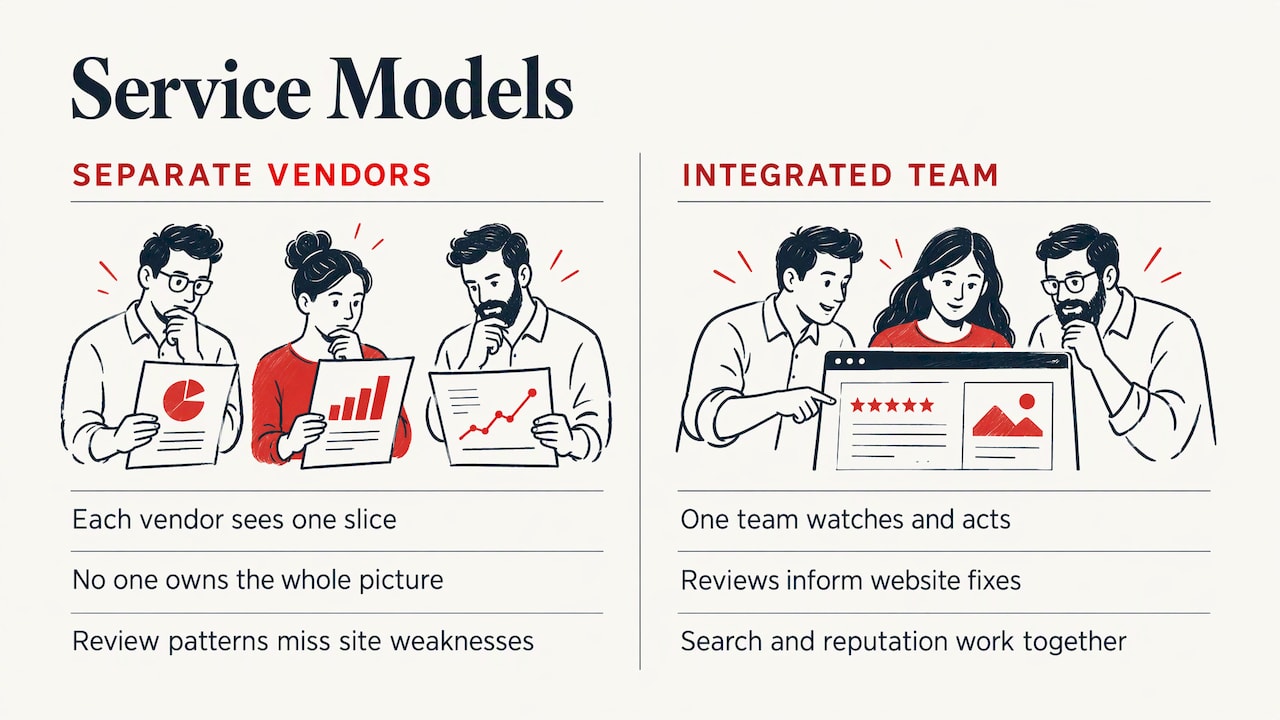
Monitoring software is one way to collect mentions. But collecting is the easy part. The harder part is what happens next: who replies, who fixes the website page that is confusing customers, who updates the listing, who asks happy customers for a review, and who tracks whether your local search position improved as a result.
When those jobs sit with different vendors, each one sees only its slice. The reputation vendor sees reviews, the SEO vendor sees rankings, the web designer sees pages, and nobody connects a pattern in reviews to a weakness on your site. That is the frustration many owners describe with traditional agency models: disjointed services and nobody accountable for the whole picture.
Our perspective on monitoring
We start from one idea: you should own your visibility, not rent it. Ads stop the moment you stop paying. A strong review record, accurate listings, a site that answers buyers’ questions and a presence in search results keep working.
That is why we do not treat monitoring as a separate product. What people say about you is the raw material for everything else: the page you rewrite, the question you answer on your site, the review you ask for, the listing you correct. Search, web design, digital marketing and reputation management are one system for us, and the team that watches the signals is the team that acts on them.
We also think small businesses deserve to speak to the people doing the work. You should know who is replying to your reviews, who is fixing your listings, and you should keep your domain, hosting and data. Local markets differ, and in Canada that includes working in both English and French. A strategy built on local knowledge will always beat a generic template.
The best first step is to find out where visibility and revenue are leaking today. That is what our Leak-Proof Audit™ is for.
DM
Where we can take this off your plate
If you have read this far and recognised your own situation, a review nobody answered, listings that do not match, a search page that does not tell your story, the next step is to see where you stand. Our free Leak-Proof Audit™ evaluates your local authority and points to where visibility and revenue are being lost. From there, our team handles SEO and local search, plus reputation and reviews, delivered in-house, with the website, digital marketing and branding work that supports it available through the full list of services.
If AI assistants are part of how your customers research, our AI and answer engine SEO service is built for that. To see how we think about the wider picture, read our guide to digital marketing strategies for local businesses in Canada.
FAQ
What is the difference between brand monitoring and reputation management?
Monitoring is the listening layer. It tells you what is being said about your business, where, by whom and in what tone. Reputation management is the action layer: replying to reviews, correcting false information, fixing the operational cause of a complaint and publishing evidence of good service. Each needs the other, because monitoring without action is only data.
What should a small business monitor first?
Start with your Google Business Profile, your main social accounts and the two or three directories your customers use. Then search your own business name and city to see what appears on page one. Add news, forums and AI assistant answers once the basics run smoothly, and include French-language terms if you serve French-speaking customers.
How quickly should I respond to a negative review?
A sensible standard is within 24 hours, and the same day when the complaint is spreading publicly or involves a safety claim. Reply once, calmly, offer to resolve it privately and correct any factual errors politely. Do not argue or ask for the review to be removed simply because it is unfavourable.
Does online reputation monitoring affect local SEO?
Yes. Review star average, review volume, the number of reviews and your replies are among the factors tied to local search visibility, and so is consistent business information across your website, social profiles and listings. Monitoring helps you keep those signals accurate and current.
Should I take down or hide bad reviews?
No. Genuine negative reviews should stay. Official consumer guidance says businesses should not discourage, edit, delay or remove honest negative feedback because it is unfavourable. Respond, fix the cause and let your record of handling problems build trust.
Sources
- Intro to Online Reputation Management, Tourism Saskatchewan
- Good practice guide on online consumer ratings and reviews, OECD, 2019
- Online Reputation Management Strategies, eLearning Industry, 2026