
Local lead generation works when you stop treating it as a campaign and build it as infrastructure: a Google Business Profile people find, a website that turns a visit into a call, and reviews that make the call an easy decision. Ads can fill the pipeline while you pay for them. A system you own keeps producing leads after the budget stops. That is the approach we build at The DM Link, and this guide explains how it works, where it leaks and how to measure it.
TL;DR
- Local lead generation means attracting people near you who are ready to buy. Your service area is small, so every lead matters more than it would for a national brand.
- Google ranks local results mainly on relevance, distance and prominence, and you cannot pay for a better local ranking. Reviews, links and a complete profile are what you can build.
- Most systems leak at the conversion stage: slow replies, weak pages, missed calls. Fix the leaks before you buy more traffic.
- Online and offline reputation work together. In a Canadian survey, businesses searching for suppliers used digital and traditional channels almost equally.
- Track calls, booked jobs and lead source, not just rankings and clicks.
Table of Contents
- What local lead generation actually is
- The four stages every local system runs through
- Step 1: Earn visibility where local customers look
- Step 2: Make the website do the converting
- Step 3: Turn reviews into a lead engine
- Step 4: Combine online and offline
- Where ads fit
- What to track
- The mistakes that keep local businesses from getting leads
- Using AI in your lead generation
- Perspective: why we build it as one system
- Find your leaks with the Leak-Proof Audit™
- FAQ
- Sources
What local lead generation actually is
A lead is a person who has shown interest in what you sell. Google’s guide for local businesses describes lead generation as turning strangers into people who have shown interest, and local lead generation as doing that within a specific geographic area. A plumber, a dental clinic or a landscaper can only serve the customers within driving distance, so the pool is a few hundred or a few thousand people, not millions.
That changes the maths in three ways:
- Targeting beats volume. Ten enquiries from the right neighbourhoods are worth more than a hundred from across the country.
- Each lead has long-term value. Google’s guide points out that every local lead is a chance to earn repeat business and referrals, which is why reputation is part of lead generation and not a separate task.
- Trust is local. People check you out on a map, read reviews from neighbours and look at who else recommends you before they call.
The four stages every local system runs through
Whatever you spend, every lead passes through the same stages. Think of them as a pipe: if any section leaks, the money you put in at the top is wasted.
| Stage | The question it answers | Typical leak |
|---|---|---|
| Search | Can people nearby find you when they look? | Incomplete or unverified Google Business Profile, thin service pages |
| Capture | Does the visit become a call, form or booking? | Slow site on mobile, buried phone number, no clear next step |
| Qualify | Is this the customer you want? | Vague forms, no service-area or budget signals |
| Convert | Does someone answer and follow up? | Missed calls, replies a day later, no follow-up |
The convert stage is where many systems fail quietly. An unanswered call does not disappear: it becomes a job for whoever picks up next. Before you invest in more visibility, check that someone answers every call and replies to every form within a working-day window you can commit to.
Step 1: Earn visibility where local customers look
For most local businesses, the first place a buyer meets you is a Google search or a map result. Google’s own help page for Business Profiles says local results are mainly based on relevance, distance and prominence. It explains the three this way:
- Relevance: how well your profile matches what the person searched for.
- Distance: how far you are from the searcher or the area they named.
- Prominence: how well known you are, which Google says is influenced partly by the number of websites that link to you and the number of reviews you have.
The same page states that there is no way to request or pay for a better local ranking. That is the core reason to build rather than rent: you cannot buy your way into the map results, but you can earn them by being the most relevant, closest and best-known option.
In practice that means:
- A complete, verified Business Profile with accurate categories, hours, services and photos.
- Service and location pages on your website that describe the real work you do in each area you serve.
- Consistent business details wherever you are listed.
- A steady flow of genuine reviews (more on that in Step 3).
- Links from local organizations, suppliers, associations and press that actually know your business.
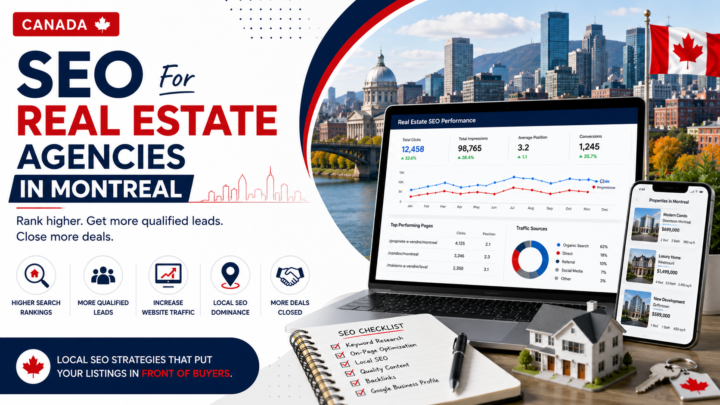
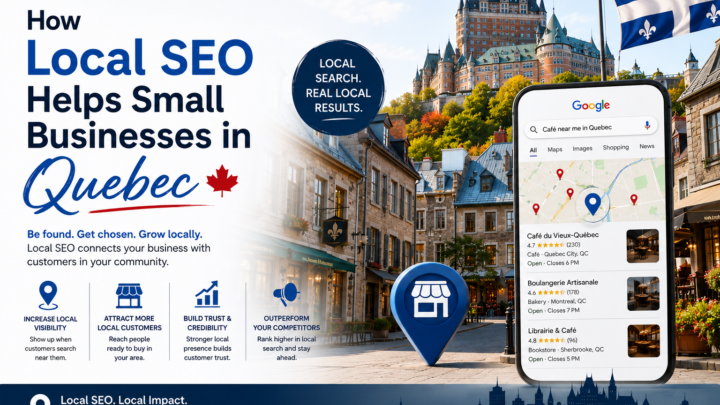
If you want the detail on how this works for trades and home services, our guide to local SEO for home service businesses in Canada walks through it. If your market is French-speaking, see how local SEO helps small businesses in Quebec. Language matters here: a profile and site written in the language your customers search in will match their queries far better than a translation.
Step 2: Make the website do the converting
Visibility without a good page behind it is the most common waste in local marketing. Someone taps your listing on their phone, lands on a slow page with the phone number three scrolls down, and goes back to the next result.
A local lead page needs to do a few things well:
- Say who you serve and where, in the first screen. City, neighbourhoods and the service, in plain words.
- Put the action within reach. A tap-to-call button and a short form, visible without scrolling on a phone.
- Show proof next to the action. Review excerpts, project photos and credentials near the button, not on a separate page.
- Ask for little. Name, phone and what they need is enough for a first contact.
- Load fast and read cleanly on mobile. Most local searches happen on a phone, in the moment of need.
One offer can lift enquiries when the buyer is unsure: a free quote, a free assessment or a short consultation. Make the next step small and specific, and the visitor is more likely to take it.
This is also where a website that is built as part of the lead system differs from a brochure site. Pages are planned around the searches you want to win and the call you want to receive. Our Smart Website Design and related services are built with that in mind, and our piece on why every Canadian small business needs a modern website explains the case in more depth.
Step 3: Turn reviews into a lead engine
Reviews do two jobs. They feed the prominence signal Google describes, and they close the decision once someone has found you. In the BDC’s June 2026 survey of Canadian businesses, reputation and relationships were what closed the deal, even as customers moved between online and offline channels.
A review routine that works for a busy owner:
- Ask at the moment of satisfaction. Right after the job is done or the appointment is complete, not weeks later.
- Make it a single tap. Send the direct review link by text or email.
- Reply to every review. Thank the happy customers by name and answer complaints calmly and specifically. Future customers read both.
- Never buy or fake reviews. They break platform rules and damage the trust you are trying to build.
- Watch for new reviews weekly. An unanswered complaint sitting for a month costs leads.
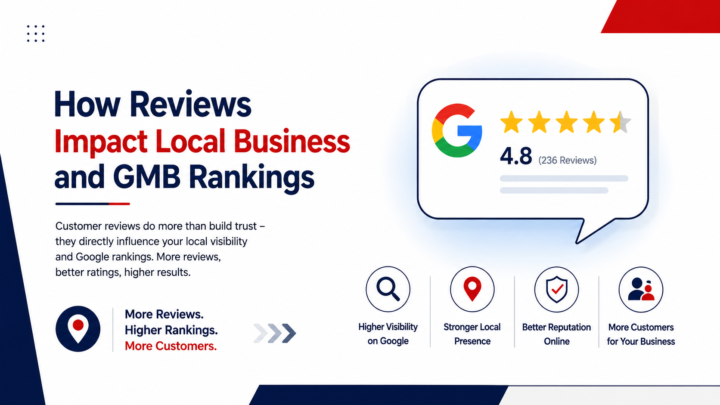
We cover the ranking side in how reviews impact local SEO and Google Business Profile rankings, and the monitoring side in what to track in brand reputation monitoring and how to act.
Step 4: Combine online and offline
Local buyers rarely use one channel. The BDC’s June 2026 survey found that no single marketing channel dominates: when Canadian businesses searched for new suppliers, they relied almost equally on digital and traditional channels, at 74% and 73%. Customers check what they find in one place against another.
For a local business, that means your message should match everywhere:
- The name, offer and tone on your van, signage or storefront should match your profile and website.
- Referrals and word of mouth should have somewhere to land: a memorable web address, a profile that confirms what the friend said.
- Local sponsorships, community events and partnerships should link back to a page on your site, which also helps the links side of prominence.
- Social media and video should show real work and real people, and point to the same call to action.
An offline referral that cannot find you online, or finds a thin profile with two reviews, is a lead you worked for and lost.
Where ads fit
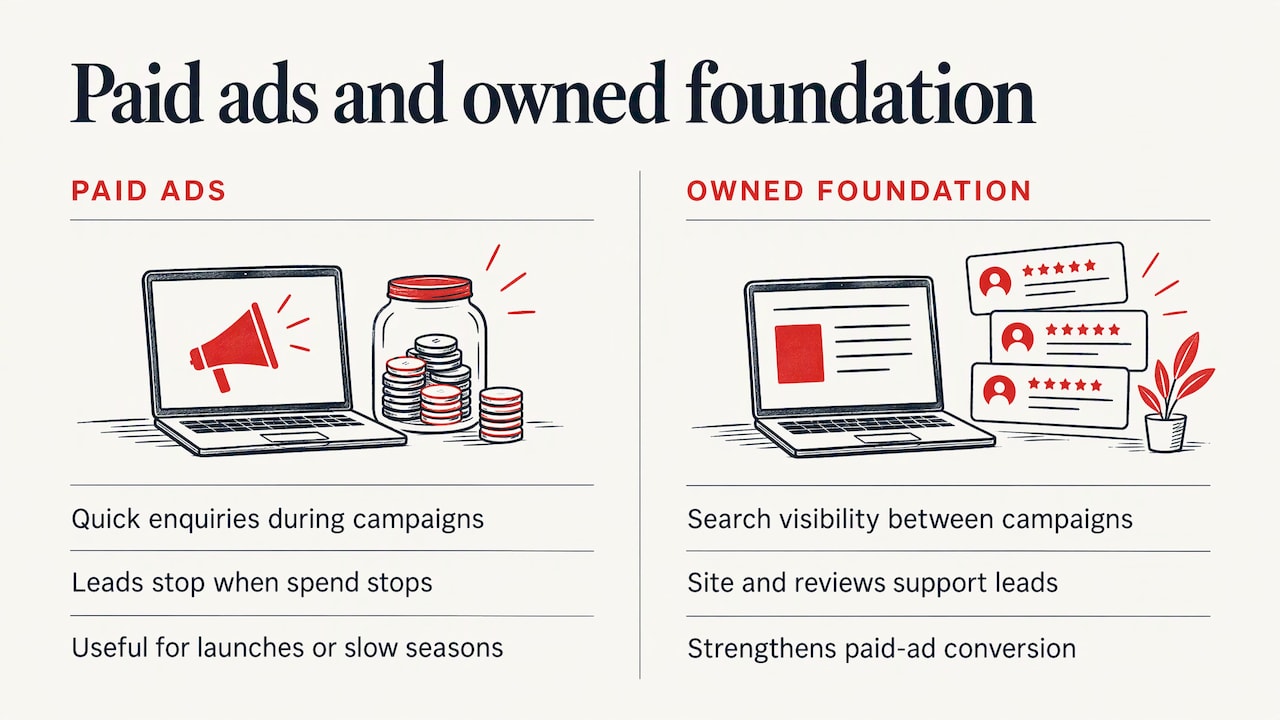
Paid ads and paid social can bring enquiries quickly, which makes them useful when you launch, add a service or need volume in a slow season. Their limit is structural: when the spend stops, the leads stop, and you have built no lasting visibility. Search visibility, a converting site and reviews keep working between campaigns, and they make any ad you do run convert better because the page and proof behind it are stronger.
We compare the two in local SEO vs Google Ads for small businesses in Canada. The short version: build the owned foundation first, then add paid traffic where it pays back.
What to track
Rankings and traffic are inputs. Leads and jobs are the result. A simple local scorecard looks like this:
| Measure | What it tells you |
|---|---|
| Calls from your Business Profile and website | Whether visibility is turning into contact |
| Form submissions and bookings | Whether the page is converting |
| Answered vs. missed calls | Whether the convert stage is leaking |
| Lead source (search, map, referral, ad) | Which channel deserves more effort |
| Leads that became booked jobs | The real quality of your leads |
| Revenue per lead source | Where the money actually comes from |
| New reviews and average rating each month | Whether your reputation is compounding |
Ask every caller how they found you and record it. It takes ten seconds and tells you more than most dashboards. Review the numbers monthly, and judge your marketing on booked calls and booked jobs, not impressions.
The mistakes that keep local businesses from getting leads
- Buying traffic before fixing the page. More visitors to a page that does not convert just raises the cost per lead.
- Treating the Business Profile as a one-time setup. Hours, photos, services and reviews need regular attention.
- Slow or inconsistent follow-up. Speed of reply decides who gets the job.
- One thin page for every service and area. Each service you want to rank for needs its own page with real content.
- Ignoring reviews. Few reviews and unanswered complaints send buyers to the next listing.
- Disconnected providers. One person builds the site, another runs ads, a third handles reviews, and nobody owns the result.
- Not owning your assets. If your domain, hosting or data sit in someone else’s account, you are renting your visibility.
Our article on 10 reasons your local SEO isn’t working in Canada goes through the technical and content causes in detail.
Using AI in your lead generation
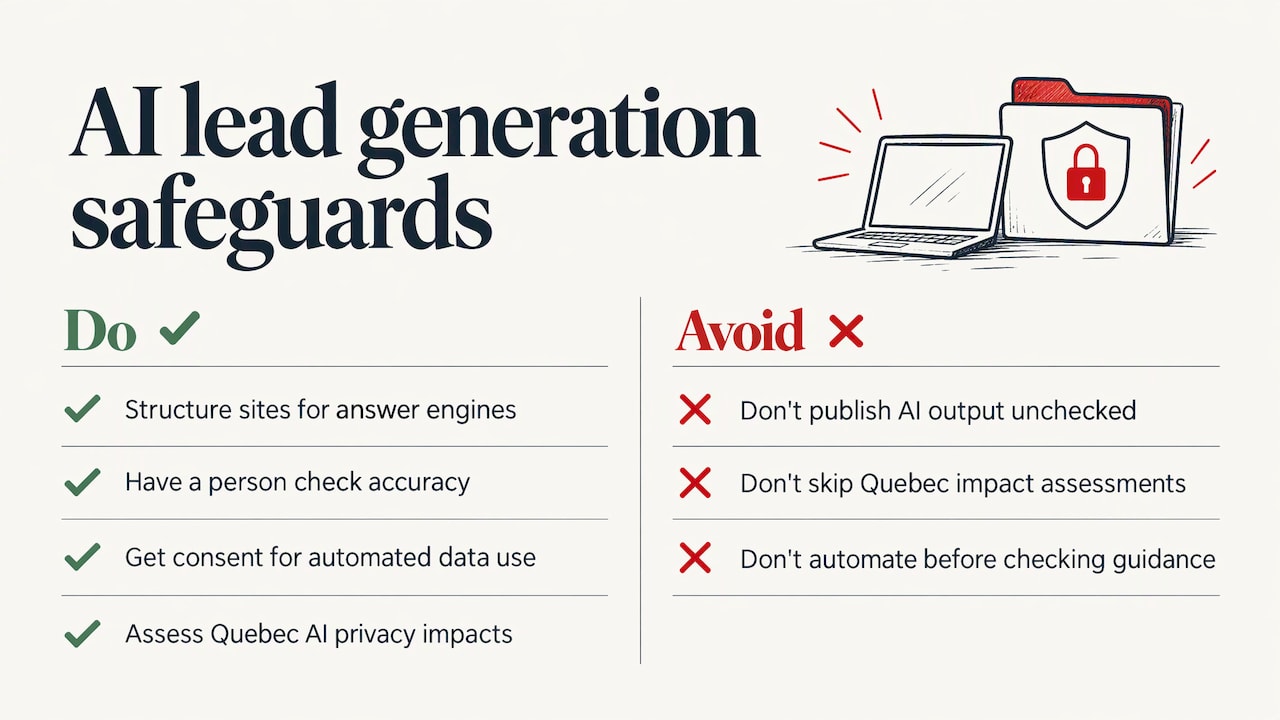
AI tools can help with drafting, summarising and organizing, and more buyers now ask AI assistants for local recommendations. That makes it worth structuring your site and profiles so answer engines can understand who you are, what you do and where. Anything that goes out under your name still needs a person to check it for accuracy. If you handle client personal data, Canadian privacy rules apply: PIPEDA requires consent for automated processing of client data, and Quebec’s Law 25 requires privacy impact assessments for AI systems that process personal information, as this Canadian summary sets out. Regulated professions, such as real estate in Ontario, carry further advertising obligations. If your business is regulated, check your regulator’s current guidance before automating client communication.
Perspective: why we build it as one system
Most businesses that come to us are not short of marketing activity. They have a website from one provider, ads from another, a profile nobody has touched in a year and reviews they never ask for. Each piece works alone, and nothing connects the search to the booked call.
We build local growth as infrastructure: search visibility, web design, digital marketing and reputation management planned together, so that visibility turns into calls. The aim is for you to own your visibility instead of renting it through ads.
Ownership is practical for us. You keep your domain, your hosting and your data. You speak directly to the team doing the work, not an account manager, and the work is delivered in-house. We serve clients in English and French, with strategies based on local market knowledge.
The question we ask first is simple: where is visibility or revenue leaking today? Answer that, and the next move is usually obvious.
DM
Find your leaks with the Leak-Proof Audit™
If you want to see where your local authority is losing visibility and revenue, we offer the free Leak-Proof Audit™. It evaluates your local authority and points to the places where leads are lost between search and the booked call. From there, our team can build the pieces you need: SEO and local search, plus reputation and reviews, or the full set of digital marketing services.
FAQ
How do I generate leads for a local business?
Start with the foundation: a verified Google Business Profile, a website with a clear call to action, and a steady flow of genuine reviews. Make sure every call and form is answered quickly. Once that works, add paid traffic or community activity to widen the reach.
What is the difference between local lead generation and regular lead generation?
Local lead generation targets customers within a defined area, so the audience is far smaller and the targeting far tighter. Google’s guide notes that a local business can only serve the people within reach. Local relevance, proximity and reviews matter much more than they would for a national campaign.
How much does local lead generation cost?
It depends on the channels, the competition in your area and how much the work involves. Ad spend is paid per click or lead, while SEO, web design and reputation work are usually project or retainer based. Our services are quoted to the business, so the best starting point is the free Leak-Proof Audit™, which shows what your situation needs.
Can ChatGPT do lead generation for me?
AI can help draft content and organize follow-up, but it does not build your local authority, collect your reviews or answer your phone. A person should review anything published for accuracy, and privacy rules such as PIPEDA apply if you process client data.
How long does it take to see results?
Paid ads can produce enquiries as soon as they run. Search visibility and reviews build progressively, because prominence grows with links and reviews over time. Track calls and booked jobs monthly to see the trend.
Sources
- Guide to lead generation for local businesses, Google
- Tips to improve your local ranking on Google, Google Business Profile Help
- The best marketing channels for SMEs in 2026, BDC
- Best AI Tools for Canadian Real Estate Agents 2026